Annual Reports
Gartner, Inc.'s annual reports contain management's most considered account of the business. These are the sections, passages and visual pages worth opening in the originals preserved in Sources.
Gartner, Inc. — FY2025 Annual Report (Form 10-K) — FY2025
The latest 10-K: the Research→Insights rename, the Digital Markets carve-out and sale, and the first contract-value stall in years. · Open the full document →
Item 1. Business — p. 4 · Read the full section →
How Gartner makes money: three segments — Insights, Conferences, Consulting — on non-cancelable annual subscriptions, 77% multi-year.
Three reportable segments, with Research renamed Business and Technology Insights in Q2 2025.
Gartner delivers its products and services globally through three reportable segments – Business and Technology Insights, Conferences and Consulting […] In the second quarter of 2025, we renamed our segment previously referred to as Research to Business and Technology Insights (or “Insights”) to reflect the nature of the value we provide to clients.
p. 4 · Read in context →
Subscription mechanics: twelve-month minimum term, and 77% of Insights contracts were multi-year at year-end 2025.
Clients normally sign subscription contracts that provide access to our content and advisory services for individual users over a defined period. We typically have a minimum contract period of twelve months for our insights subscription contracts and, at December 31, 2025, 77% of our contracts were multi-year.
p. 6 · Read in context →
Item 1A. Risk Factors — p. 12 · Read the full section →
The company-specific risks that could bite: AI/LLMs substituting for Gartner research, and dependence on renewals (~78% of revenue).
Renewal dependence: subscription products were ~78% of 2025 revenue; a slip in renewals flows straight to the top line.
Our Insights business depends on renewals of subscription-based services and sales of new subscription-based services for a significant portion of our revenue, and our failure to renew at historical rates or generate new sales of such services will lead to a decrease in our revenues. […] These products and services constituted approximately 78% and 77% of total revenues from our operations for 2025 and 2024, respectively.
p. 14 · Read in context →
Item 7. MD&A — Recent Developments — p. 39 · Read the full section →
Management's own account of what hurt 2025: a collapse in US-federal contract value and a $150m Digital Markets goodwill impairment.
Item 7. MD&A — Business Measurements — p. 41 · Read the full section →
Defines the KPI that runs the story — Contract Value — plus client and wallet retention, the leading indicators of the subscription base.
Contract Value defined: annualized value of all subscription contracts in effect — the signal of long-term subscription health.
Contract value represents the dollar value attributable to all of our subscription-related contracts. It is calculated as the annualized value of all contracts in effect at a specific point in time, without regard to the duration of the contract. […] Comparing contract value year-over-year not only measures the short-term growth of our business, but also signals the long-term health of our Insights subscription business since it measures revenue that is highly likely to recur over a multi-year period.
p. 41 · Read in context →
Item 7. MD&A — Segment Results: Insights — p. 51 · Read the full section →
The core engine up close: contract-value growth stalled to +1% and wallet retention fell to 96% (GTS) as clients spent less.
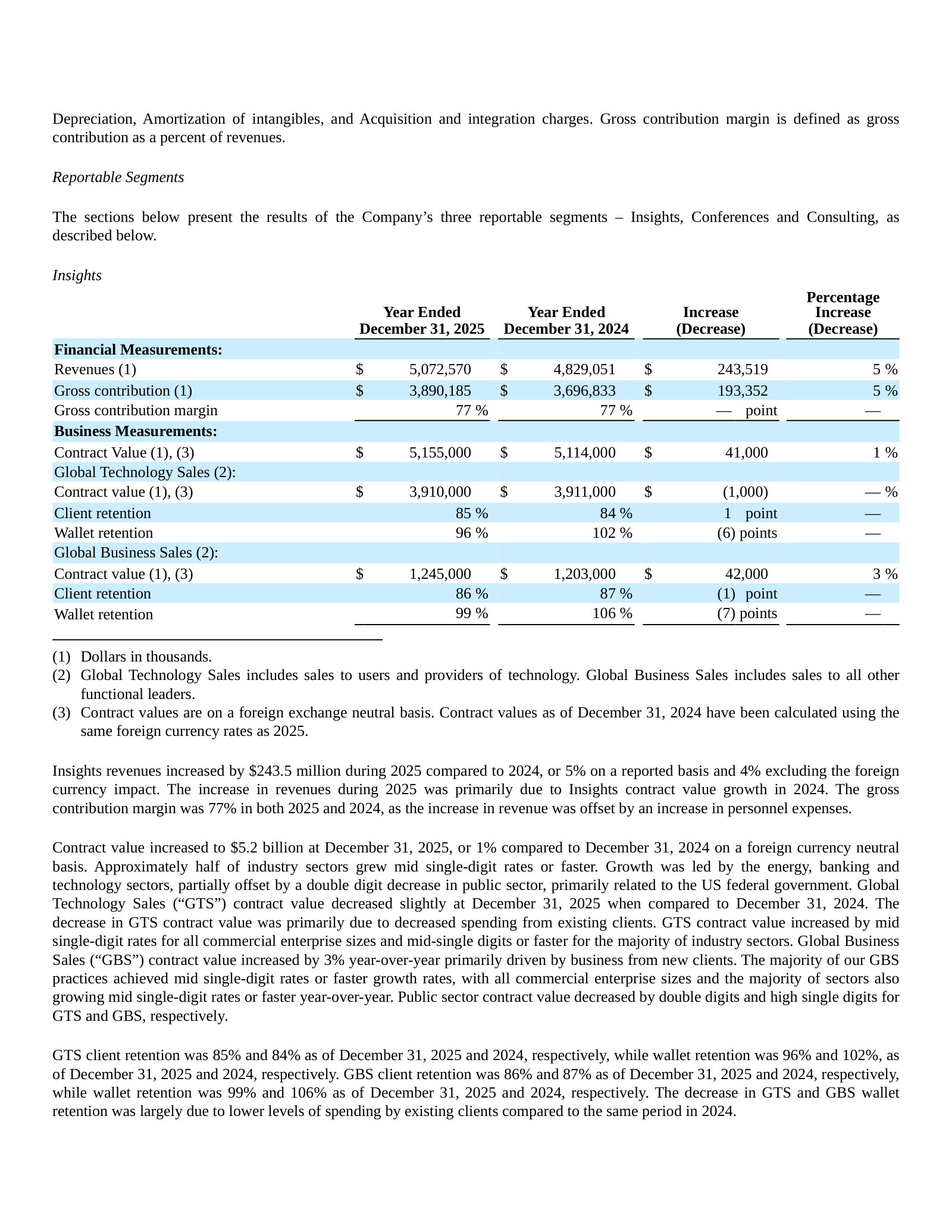
Why CV barely grew: public-sector/US-federal declines offset mid-single-digit gains elsewhere; retention fell on lower spend.
Contract value increased to $5.2 billion at December 31, 2025, or 1% compared to December 31, 2024 on a foreign currency neutral basis. Approximately half of industry sectors grew mid single-digit rates or faster. Growth was led by the energy, banking and technology sectors, partially offset by a double digit decrease in public sector, primarily related to the US federal government. […] The decrease in GTS and GBS wallet retention was largely due to lower levels of spending by existing clients compared to the same period in 2024.
p. 51 · Read in context →
Note 9 — Revenue and Related Matters — p. 101 · Read the full section →
The accounting policy that defines the model: Insights fees are billed up front, deferred, and recognized ratably over the contract.
Subscription revenue recognized ratably; contracts generally non-cancelable, billed amounts booked as deferred revenue.
Insights revenues are derived from subscription contracts for insights products, representing substantially all of the segment’s revenue. The related revenues are deferred and recognized ratably over the applicable contract term (i.e., as services are provided over the contract period). […] Insights contracts are generally non-cancelable and non-refundable, except for government contracts that may have cancellation or fiscal funding clauses, which have not historically resulted in material cancellations. When a subscription contract is invoiced, the Company records the billable amount as a fee receivable, representing its legally enforceable right to payment. The corresponding amount is recognized as deferred revenue until the underlying services are provided and control is transferred to the customer.
p. 101 · Read in context →
Gartner, Inc. — FY2024 Annual Report (Form 10-K) — FY2024
Shown for one reason: the segment was still called 'Research' and Digital Markets sat inside it — the 'before' of the 2025 recast. · Open the full document →
Item 1. Business — p. 4 · Read the full section →
The 'before': in FY2024 the segment was named Research, built on ~2,500 research experts — renamed Business and Technology Insights in 2025.
FY2024's 'RESEARCH.' segment description — the framing Gartner replaced with 'Insights' the following year.
RESEARCH. Gartner delivers independent, objective insight to leaders across an enterprise through subscription services that include on-demand access to published research content, data and benchmarks, and direct access to a network of more than 2,500 research experts located around the globe. […] Gartner research is the fundamental building block for all Gartner products and services. We combine our proprietary research methodologies with extensive industry and academic relationships to create Gartner products and services that address each role across an enterprise.
p. 6 · Read in context →
More annual reports
Gartner, Inc. — FY2023 Annual Report (Form 10-K) — FY2023 · 128 pages · FY2023 10-K — Research/Conferences/Consulting structure pre-rename; a baseline for contract-value and retention trends. · Open →
Gartner, Inc. — FY2022 Annual Report (Form 10-K) — FY2022 · 127 pages · FY2022 10-K — post-pandemic normalization, with conferences returning toward in-person scale. · Open →
Gartner, Inc. — FY2021 Annual Report (Form 10-K) — FY2021 · 135 pages · FY2021 10-K — earliest edition on file; the pandemic-era conferences trough and the recovery setup. · Open →